'Our strategy should be to 'hold the line' in the north on the Sino-Indian land frontier, but maintain and, if possible, enlarge India's current edge in the maritime south.'

'China might soon have to seriously consider whether it prefers an Indo-US hyphenation to a Sino-Indian one.'

'In Chinese perception, India is strategically getting closer to United States and some Chinese analysts fear perhaps one day it may become a part of American arrangements against China.'

Beijing is clearly rattled by the Dalai Lama's visit. Unlike the 2009 visit, which was a four-day religious tour, the current visit is a high-decibel, 10-day affair, without the fig leaf of a "religious event", reports Ajai Shukla.

'There are major implications for India. Though there was a transparently thin attempt to project the troop reduction as intended to promote peace, the downsizing is actually part of plans to streamline and strengthen the PLA, capable of defending China's national interests at home and abroad,' says Jayadev Ranade.

The Chinese leader will display his grip on the Communist party and chart his plans for his country's future.

In the test, a space rocket boosted a hypersonic glide vehicle, one capable of carrying a nuclear device, which circled the globe before impacting.
'Given the present force levels, India cannot fight and win.' 'India can't hope to terminate the conflict on India's terms and impose the nation's will upon the adversaries,' says Brigadier Gurmeet Kanwal (retd).
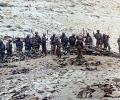
In fact, given the current tensions and massed troops on both sides, there is a danger that the LAC will become more like the Line of Control with Pakistan, a heavily fortified and strongly defended border where weapon fire exchanges regularly occur. Indeed, Stratfor Worldview research has listed a sharp increase in new Chinese facilities along the LAC in 2019-20.

'Like Nehru, too, Modi has found dealing with Beijing more and more difficult and has adopted an increasingly assertive approach towards managing India's northern neighbour.'

52 world leaders, including Narendra Modi, will attend this week's Nuclear Security Summit in Washington, DC. Obama will meet separately only with the Chinese president.

'When Modi was having his maiden meeting with Donald Trump, China is up to its old tricks again, by causing a distraction on the Doklam plateau,' says B S Raghavan, the distinguished civil servant.

'After a strategic pause though, Beijing will revive its policy of slowly creeping towards acquiring sovereignty over the South China Sea.'

As Chinese army incursions continue to recur, India has cautioned China that any disturbance of peace and tranquility in the border areas can vitiate the overall atmosphere of bilateral ties.

The International Fleet Review, conceived as a show of the country's naval might and readiness for battle, saw as many as 100 naval ships, including 70 from the Indian Navy, taking part in the second edition of the coveted event.
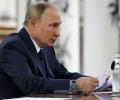
Putin said the purpose of the West is to weaken, divide and ultimately destroy Russia.

The India-Japan joint naval exercises are a strategic signal for China, observes Dr Rajaram Panda.
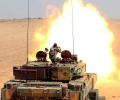
For some inexplicable reason, the army prefers to use Russian armour; Arjun is deployed in only two of its 63 armoured regiments.

Both protesters and the authorities in Hong Kong are using complex combinations of technology, reports Devangshu Datta.
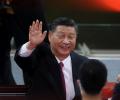
Xi's visit to Nyingchi, bordering Arunachal Pradesh, signals China's opening of another front to India in the eastern sector, observes Srikanth Kondapalli, the leading China expert.

Dai Bingguo, who served as the China's boundary negotiator with India from 2003 to 2013, told Chinese media, "If the Indian side takes care of China's concerns in the eastern sector of their border, the Chinese side will respond accordingly and address India's concerns elsewhere."

On the title page of the Top Secret Report, Henderson-Brooks quotes the Chinese tactician Sun Tzu: 'Know yourself, know your enemy: A hundred battles, a hundred victories', says Claude Arpi, highlighting where the Indian Army and government failed to counter the Chinese attack in 1962.

'This is the only place on earth where Elephas maximus climbs to these heights.'
Chinese leaders may well respond to challenges with heightened rhetoric.

Indian intelligence agencies have often claimed that left-wing extremists are trying to make inroads in the militancy-hit regions of north-east to foment further unrest. But Jaideep Saikia, noted terrorism and conflict analyst, claims, "People who speak of Maoism taking roots in the north-east have not read history".

The chaos on its stock markets, a fierce battle between the old and new guard in the Communist Party and the restive border provinces of Tibet and Xinjiang forebode tough times ahead for China, says Claude Arpi.

'Clearly, there is a wide gap between the stated intentions of China's top leadership to improve relations with India and the PLA's aggressive border management,' says Brigadier Gurmeet Kanwal (retd).
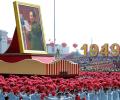
'The leadership is confronted with an economy growing at its slowest pace in 20 years,' points out Claude Smadja.

The massive earthquake in Sichuan struck at 9:19 pm (local time) on Tuesday and the epicentre was monitored at a depth of 20 km, state-run Xinhua new agency reported.

Building relations in the Indian Ocean, New Delhi has gifted naval vessels to Mauritius, the Maldives and Sri Lanka, even as China eyes the same locales.
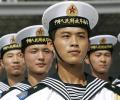
Right from conducting nuclear deterrence patrols in 2015 to its destructive space programme, from its back-tracking on economic commitments to its hardened positions on Sino-India border deal -- its approach with India spells Adversarial with a capital A, says Shehzad Poonawalla

Fires are still burning at the site of the two massive explosions some 36 hours after the blasts as another 6,200 people were evacuated to prevent further casualties.

'Even if such a thing happens, it will not prolong for many days like Doklam did.' 'That is because both the leaders do not want it.'

'Prime Minister Manmohan Singh may be anxious for a farewell visit to Washington in October,' says retired Ambassador K C Singh, 'but bending backwards on America's PRISM policy is going to earn him scorn at home and contempt abroad.'

'We should not flatter ourselves that China is fixated on encircling India. She has greater goals, becoming the pre-eminent power in the world, and India as a major power is dealt with as part of that strategy.'

Though the Chinese find it necessary to oppose the visits of Indian leaders to Arunachal Pradesh, they want to keep the objections at a moderate level lest it cast a shadow on Narendra Modi's visit to China in May, says D S Rajan.
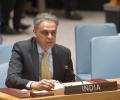
'It must be rendering Modi, Amit Shah and Adityanath speechless that the Indian diplomat who lifted the Azhar trophy at the UN in New York is also a Muslim. 'Yes, this is the wonder that was India,' says Ambassador M K Bhadrakumar.

When China protested strongly over the August decision on J&K -- not once but twice -- we ignored it. And to compound matters, we simply turned our back and walked over to the 'Quad' alliance with the US, upgrading it to ministerial level, and thereafter began following the American footfalls on Taiwan and COVID-19 to taunt and humiliate Beijing, observes Ambassador M K Bhadrakumar.

Very few today realise that without Brigadier John Dalvi's courage, we would never have known what really happened during those tragic days of October/November 1962, reveals Claude Arpi.

Confronting a slowdown in growth, China says it will only increase its defence budget by 7.6% this year, against the anticipated rise of between 20% and 30%. 'It is difficult to explain the reduction in the Chinese defence budget,' says Claude Arpi. 'Is there a hidden budget? Possibly!'
